Blog
The Minimum Dose of Exercise That Actually Protects Your Heart
Exercise & FitnessPrevention & ScreeningLifestyle & Wellness
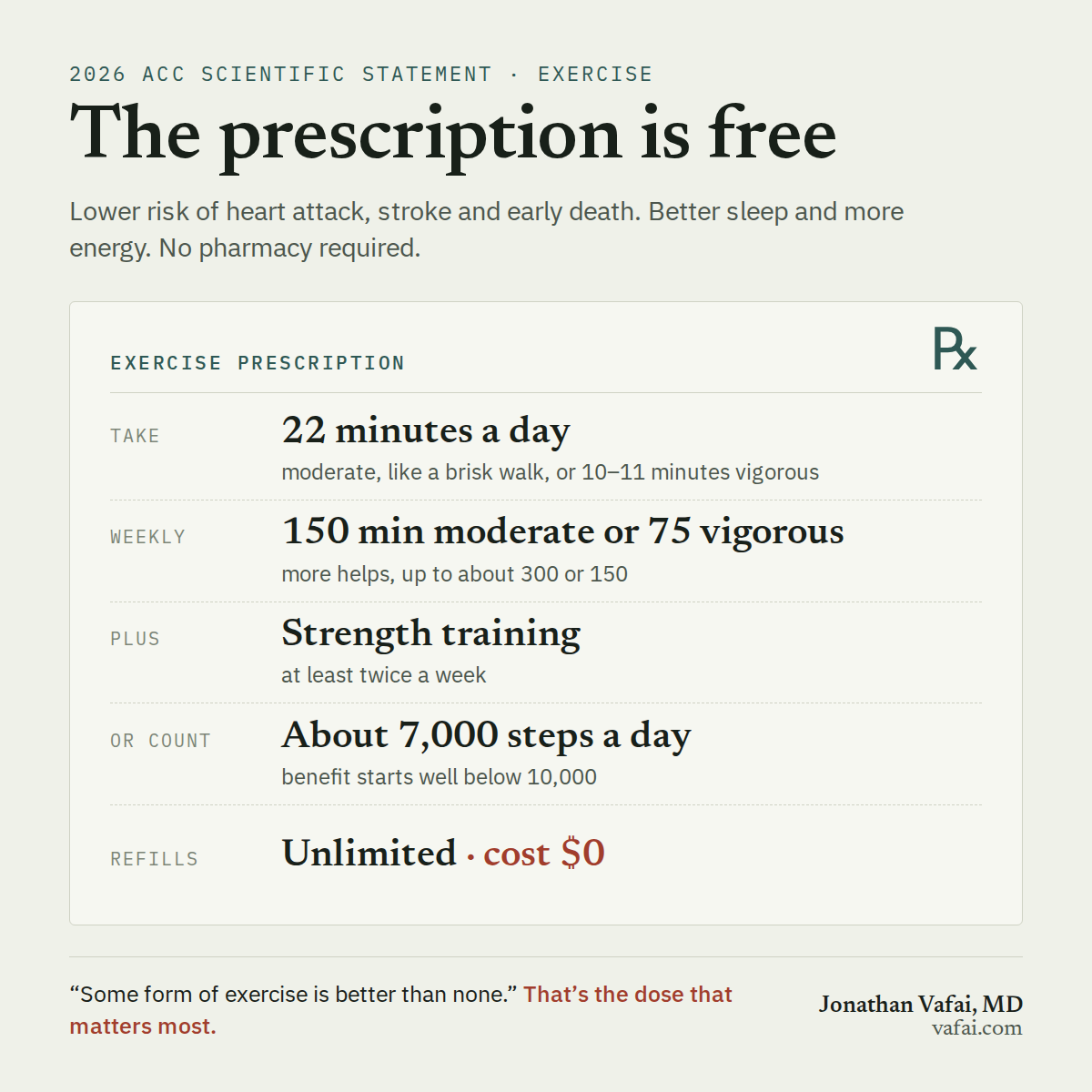
If I told you I had a new treatment that lowered your risk of heart attack, stroke, and early death, helped you lose weight and keep it off, gave you more energy, and helped you sleep better, you'd probably ask me to write the prescription today. It isn't new, it doesn't come in a bottle, and it's free. It's exercise. The American College of Cardiology has just published new guidance urging doctors to actually prescribe it, and its central message is one I wish every patient heard: the biggest payoff comes the moment you go from doing nothing to doing something. One of its authors, Dr. Paul Thompson, put that in practical terms at a preventive cardiology conference this summer. By his read of the research, about 22 minutes of moderate activity or 10 minutes of vigorous activity a day captures most of the heart protection exercise provides.
Key Findings & Takeaways
- What's new: In October 2026 the ACC released a scientific statement (expert guidance from the college, a step short of a formal guideline) urging doctors to prescribe exercise as a core part of preventing and treating heart disease, with specifics on how much, how hard, and what kind. It covers aerobic exercise, strength, balance, and flexibility, for healthy adults and for people living with heart disease.
- The weekly target: At least 150 minutes of moderate activity or 75 minutes of vigorous activity a week, with added benefit up to about 300 and 150 minutes, plus strength training at least twice a week for most adults. That's still what I recommend patients build toward over time.
- The daily version: Spread across a week, 150 minutes is about 22 minutes a day, and 75 vigorous minutes is about 10 or 11. That's the figure Dr. Thompson highlighted. Treating it as a daily habit rather than a weekly quota makes it much easier to hit, and it means the "minimum" isn't some small fraction of the guideline. It is the guideline, broken into bite-sized pieces. And if weekends are all you've got, the statement notes that packing your activity into one or two days appears to lower heart risk about as much as spreading it out.
- Something beats nothing: The statement says the greatest gains go to people who are inactive and start moving. More exercise still helps, with each added minute giving a little less than the one before, within whatever limits your own heart condition sets.
- An honest word on weight: The statement is clear that exercise on its own usually isn't enough to lose much weight. Paired with healthier eating, it helps you lose more and keep it off, and it improves your fitness and quality of life whatever the scale says.
- Steps count too: If you'd rather count steps than minutes, the statement calls about 7,000 steps a day a practical, achievable target for many adults. In the studies it reviewed, benefit started showing up at around 2,500 steps a day, so 10,000 is a fine goal but not the cutoff.
- It doesn't have to be a workout: Moderate activity raises your heart rate and breathing enough that you can talk but not sing. Brisk walking, gardening, and taking the stairs all count. Vigorous means you can only get out a few words at a time. No gym membership required.
- You probably don't need a stress test first: For most people without symptoms, the statement says routine testing before starting to exercise isn't needed. If you have heart disease, chest pain, or unusual shortness of breath, talk with your cardiologist first. They may tailor the plan or refer you to cardiac rehabilitation (a supervised exercise program after a heart diagnosis or event).
If you're doing nothing right now, your first 10 minutes of walking will do more for your heart than any minutes you add later. This is general information, not advice about your heart, so check with your own doctor before starting something new, especially if you have a heart condition.
Reference Source: American College of Cardiology — ACC Scientific Statement Calls For Exercise Prescription as Key Element of Routine CV Care
Journal Article: Journal of the American College of Cardiology — Exercise Prescriptions for Cardiovascular Health in Adults: 2026 ACC Scientific Statement
Reference Source: Healio — Speaker: 22 minutes of activity per day can improve heart health
This article relates to Preventive cardiology — learn how Dr. Vafai can help or schedule a visit.