A lot of my week is spent in the echocardiography lab, reading ultrasound pictures of the heart. When I see a heart wall that's thicker than a patient's blood pressure history can explain, I go back through the chart looking for a particular set of clues. Together they can point to transthyretin amyloid cardiomyopathy (ATTR-CM), where a protein called transthyretin misfolds and builds up in the heart muscle, stiffening it. We used to think of it as rare. It isn't, and because its earliest symptoms often show up in the hands, tendons and spine rather than the heart, it can go unrecognized for years.
Key Findings & Takeaways
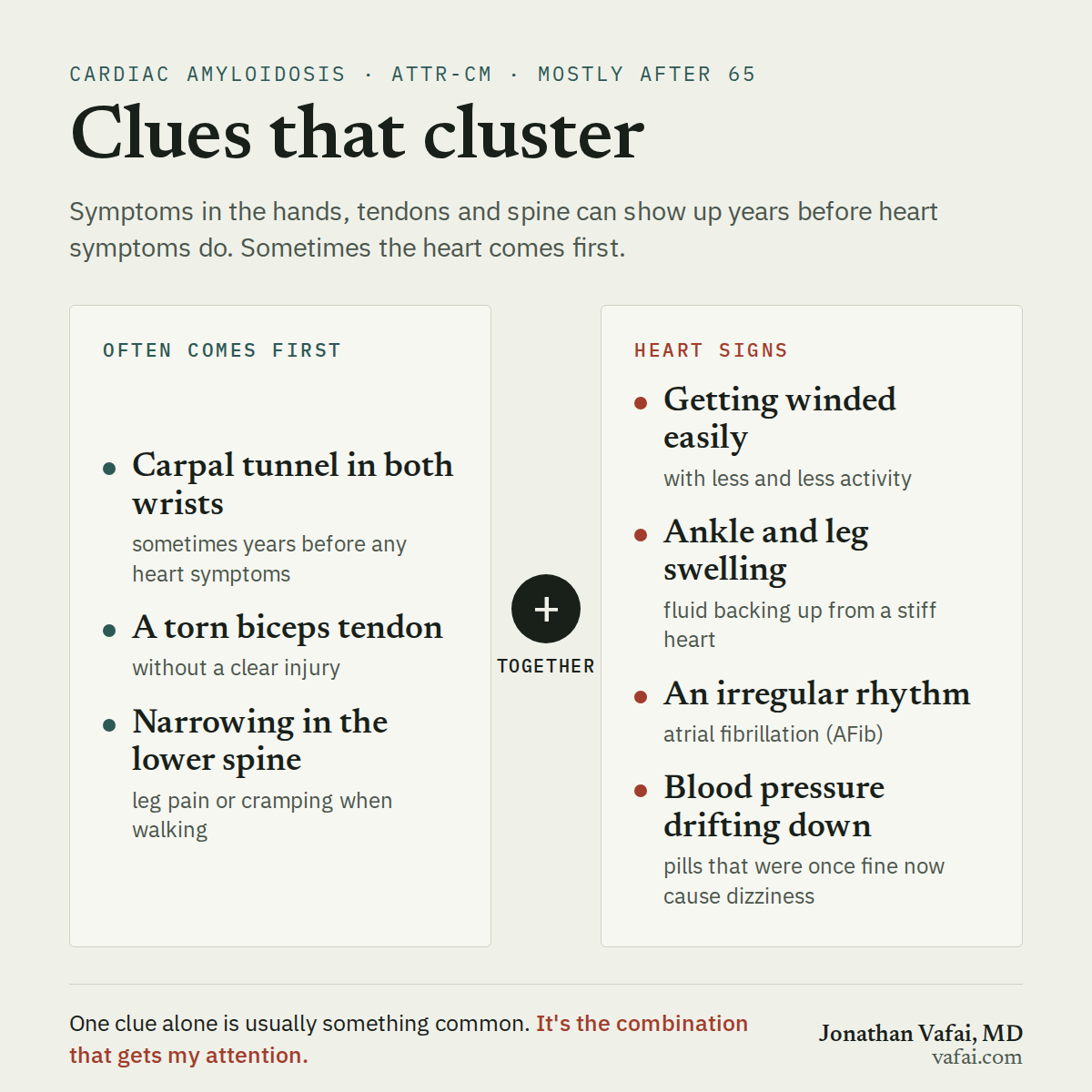
- The clues that often come first: Carpal tunnel syndrome in both wrists, sometimes years before any heart symptoms. A torn biceps tendon without a clear injury, where the muscle bunches up in the upper arm. Lumbar spinal stenosis, a narrowing in the lower spine that causes leg pain or cramping when you walk. Each of these is common on its own. It's the combination that gets my attention.
- The heart signs: Shortness of breath with less and less activity, swelling in the ankles and legs, and atrial fibrillation (AFib), an irregular heart rhythm. Many have already been told they have heart failure with "normal" pumping strength: the heart squeezes fine but is too stiff to fill properly. For some people, these heart signs are the first clue, with no carpal tunnel or tendon problems at all.
- A clue patients often notice themselves: Blood pressure that used to be high drifts down to normal or low, and pills that used to be fine start making you dizzy, until your doctor cuts back or stops them. A stiff, amyloid-filled heart pumps out less blood with each beat.
- Who gets it: The age-related type (doctors call it wild-type) involves no gene change and usually shows up after 65. It's diagnosed far more often in men, but it's probably missed in women, so being a woman doesn't rule it out. Hereditary ATTR comes from an inherited gene change. The most common one in the U.S., carried by about 3 to 4% of Black Americans, mainly affects the heart and tends to show up later in life, much like the age-related type. Many people who carry a gene change never develop the disease.
- Signs of the other hereditary types: Other inherited gene changes can start earlier, sometimes in middle age, and also affect the nerves and gut. That can mean numbness, tingling or burning in the feet, alternating diarrhea and constipation, feeling full quickly, and lightheadedness when you stand up. Some also cause floaters in the eyes. If you're Black, or a relative has been diagnosed with ATTR, mention that to your doctor.
- How we diagnose it now: Most people no longer need a heart biopsy. An echocardiogram raises the question, and a nuclear scan (PYP or DPD) that lights up where this amyloid has built up can confirm it, together with blood and urine tests. Those tests matter because they rule out a different type, AL amyloidosis, which comes from a blood cell disorder and needs urgent, different treatment. If it's ATTR, a genetic test tells us which type and whether family members should be checked.
- Why finding it early matters: Three medicines are now approved for ATTR-CM, for both the age-related and hereditary types. Tafamidis and acoramidis hold the transthyretin protein together so it doesn't break apart and misfold, and vutrisiran lowers how much of it the liver makes. In large trials, each one led to fewer deaths or heart-related hospital stays than a placebo. They slow the damage but don't reverse it, so it helps to find ATTR-CM before the heart has stiffened badly.
If you're older and recognize a cluster of these, especially carpal tunnel in both hands along with getting winded or leg swelling, it's a fair question to bring to your doctor: could this be amyloid? An echocardiogram is usually where the answer starts. Any one of these on its own is far more likely to be something common. This is general information, not advice about your heart. For the record, I have no financial ties to the companies that make these medicines.
Reference Source: Journal of the American College of Cardiology — 2023 ACC Expert Consensus Decision Pathway on Comprehensive Multidisciplinary Care for the Patient With Cardiac Amyloidosis
Journal Article: New England Journal of Medicine — Tafamidis Treatment for Patients with Transthyretin Amyloid Cardiomyopathy (ATTR-ACT)
Journal Article: New England Journal of Medicine — Efficacy and Safety of Acoramidis in Transthyretin Amyloid Cardiomyopathy (ATTRibute-CM)
Journal Article: New England Journal of Medicine — Vutrisiran in Patients with Transthyretin Amyloidosis with Cardiomyopathy (HELIOS-B)
This article relates to Preventive cardiology — learn how Dr. Vafai can help or schedule a visit.