Blog
Soft Plaque vs. Calcium: What a Coronary CTA Sees That a Calcium Score Can't
Prevention & ScreeningTechnology & Innovation
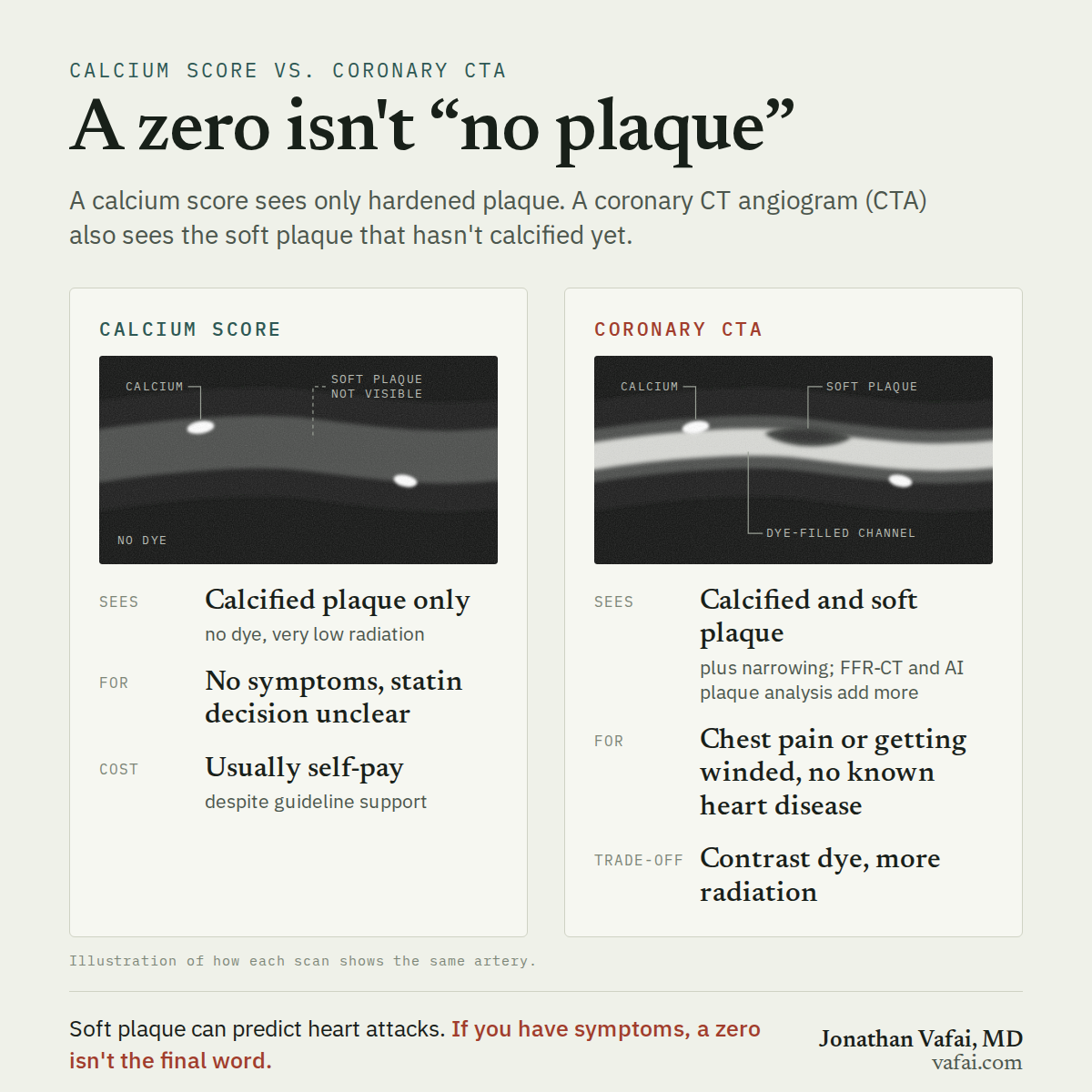
Patients often bring me their calcium score like a report card, and a zero feels like a clean bill of health. If you have no symptoms, it really is good news. But a calcium score sees only one kind of plaque, the hardened, calcified kind. It misses soft plaque: deposits in the artery wall that haven't calcified yet. Some of it, especially the cholesterol-rich kind, is more prone to rupture and cause a heart attack. A coronary CT angiogram (CTA), a CT scan with contrast dye that shows the inside of the heart arteries, can see both.
Key Findings & Takeaways
- Calcified vs. soft plaque: Over years, some plaque hardens with calcium, and that calcium is all a calcium score counts. Soft plaque, also called noncalcified plaque, is often earlier and can be less stable. A score of zero means "no calcified plaque," not "no plaque."
- What a zero can miss: In CONFIRM, which followed over 10,000 people with chest symptoms who had both tests, about half had a calcium score of zero. About 1 in 6 of those still had plaque on CTA, including 3.5% with a significant narrowing. Without symptoms, a zero is still very reassuring.
- Why soft plaque matters: In a follow-up analysis of SCOT-HEART, a trial in people with stable chest pain, the amount of cholesterol-rich soft plaque predicted heart attacks better than the calcium score or the degree of narrowing. Those with more than a small amount were nearly five times as likely to have a heart attack over about five years, though heart attacks were uncommon overall.
- What the add-ons tell you: FFR-CT uses the same scan to model blood flow, so for a moderate narrowing it helps decide between medication alone and a catheterization (an invasive test that threads a thin tube to the heart). AI plaque analysis measures how much plaque there is and how much of it is soft. It's useful, but the numbers aren't standardized between programs yet, and repeat scans to track plaque aren't a proven strategy.
- Seeing plaque changes what people do: In SCOT-HEART itself, adding a CTA to usual care lowered the rate of death from heart disease or heart attack over five years (2.3% versus 3.9%), without more catheterizations or stents overall. That's likely because more people started preventive medicines once they could see their plaque.
- The honest gap: SCOT-HEART showed that seeing plaque helped; it didn't test acting on soft plaque specifically. The goal is to catch soft plaque while it's still hiding and treat it, mainly with cholesterol lowering and lifestyle, but no trial yet shows that treating based on soft plaque prevents more heart attacks than treating standard risk factors. I think it's a reasonable bet, but it's still a bet.
- Who it's for, and the trade-offs: This test is meant for people with symptoms, like chest pain or getting winded with exertion, and no known heart disease. That's where guidelines recommend it, and where Medicare and many insurers cover FFR-CT, and increasingly plaque analysis. Without symptoms, insurance generally won't cover a CTA. If you feel fine but your need for a statin is unclear, a calcium score is the usual next step; guidelines support it, but Medicare and most insurers don't pay for it, so it's usually a modest out-of-pocket cost. A CTA also means contrast dye, more radiation than a calcium score, and often a medicine to slow your heart rate, so it isn't right for everyone, including some people with kidney disease or a contrast allergy.
If you have symptoms and your calcium score was zero, don't treat that as the final word; ask whether a CTA makes sense for you. New, worsening or at-rest chest pain needs prompt attention, not a scheduled scan. If you feel fine, a calcium score is still a good place to start. This is general information, not advice about your heart.
Reference Source: Journal of the American College of Cardiology — 2021 AHA/ACC/ASE/CHEST/SAEM/SCCT/SCMR Guideline for the Evaluation and Diagnosis of Chest Pain
Journal Article: Journal of the American College of Cardiology — Prevalence and Severity of Coronary Artery Disease and Adverse Events Among Symptomatic Patients With Coronary Artery Calcification Scores of Zero (CONFIRM)
Journal Article: Circulation — Low-Attenuation Noncalcified Plaque on Coronary Computed Tomography Angiography Predicts Myocardial Infarction (SCOT-HEART)
Journal Article: New England Journal of Medicine — Coronary CT Angiography and 5-Year Risk of Myocardial Infarction (SCOT-HEART)
Journal Article: Journal of the American College of Cardiology — 2019 ACC/AHA Guideline on the Primary Prevention of Cardiovascular Disease: Executive Summary
This article relates to Tests & procedures — learn how Dr. Vafai can help or schedule a visit.